Week 10: March 9-15
March 9, 1926
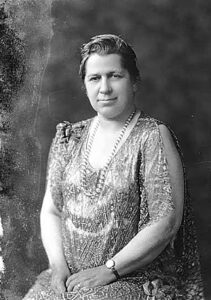
On this day, Bertha Knight Landes was elected mayor of Seattle, becoming the first woman executive of a major American city.
She followed through on her pledge to perform “municipal housekeeping” and led an honest, scandal-free administration during her single, two-year term.
March 9, 1995
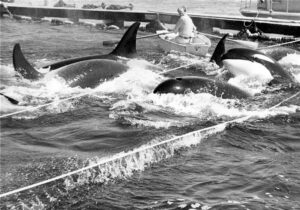
On this day, Washington Secretary of State Ralph Munro joined with Governor Mike Lowry to launch a “Free Lolita!” campaign.
Lolita, an orca, had been held in captivity since August 8, 1970, when she was taken from Penn Cove off Whidbey Island and later sold to Miami Seaquarium. The Center for Whale Research in the San Juan Islands set a fundraising goal of $2 million to bring Lolita back from Florida to live out the rest of her days in her native waters.
Yet despite ongoing protests by activists and several lawsuits, Lolita would reside at Miami Seaquarium for more than 50 years after she was rounded up, captured, and sold, and died there on August 18, 2023.
March 13, 1939
On this day, the Seattle City Council passed a resolution establishing the Seattle Housing Authority (SHA) and eight months later signed an agreement under which the SHA will provide housing for low-income and disadvantaged citizens in the city.
It is the first public-housing authority in the state, and in May 1939, received $3 million to develop Yesler Terrace.
Public-housing activist Jesse Epstein chaired the housing authority commission. By 2009, the SHA had expanded to house 26,000 residents at more than 400 sites.
March 13, 1962
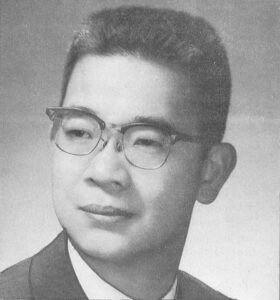
On this day, Wing Luke was elected to the Seattle City Council. He became the council’s first non-white member and the first Chinese American elected to a major post in the continental United States.
During his brief tenure on the Seattle City Council, Luke quickly distinguished himself as a champion of civil rights, progressive reform, and urban conservation. Victor Steinbrueck (1911-1985) credited Luke with sparking the movement that saved the Pike Place Market.
Luke disappeared on May 17, 1965, while flying over the Cascades in a small plane with philanthropist Sidney Gerber and Kate Ladue. The wreckage was found many years later. His memory is now honored by the Wing Luke Museum of the Asian American Experience.
March 14, 1895
On this day, the Washington State Legislature approved what was commonly called the “Barefoot Schoolboy Act,” which, for the first time, provided a uniform means of producing recurring income for the state’s public schools by imposing a direct tax.
Prior to the act, educational funds were derived from a welter of sources, none of which were very predictable, and some of which, due to circumstance, tended to favor a few districts over others. The bill required the state to impose an annual tax on the value of property sufficient to provide, in combination with other available funds, a minimum of $6 per year for each school-age child in the state.
March 14, 1911
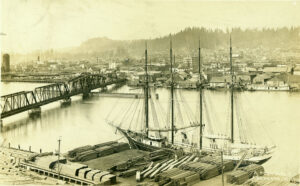
On this day, Governor Marion E. Hay signed legislation authorizing the establishment of public port districts.
The Port District Act, which allows citizens to end private monopoly control of urban harbors, was a victory for progressive and populist reformers then at the height of their influence in Washington. Voters in Seattle and Grays Harbor would go on to create the first two port districts later that year, and many more would be established around the state in succeeding years.
This post is in partnership with HistoryLink, and Warren Seyler, former chairman Spokane Tribe of Indians, the Black Muse Resource Center, and the Living Arts Cultural Heritage.
We encourage you to engage in further research through your local historic societies, museums, archives, and community.