Week 20: May 18-24
May 18, 1952
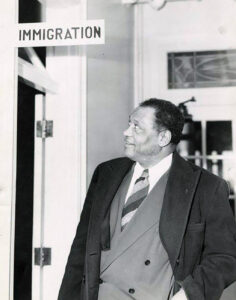
On this day, singer, actor, athlete, scholar, and political activist Paul Robeson performed an outdoor concert for more than 25,000-45,000 people gathered on both sides of the United States/Canadian border at Peace Arch Park in Blaine. An outspoken supporter of civil rights worldwide and an admirer of the Soviet Union, where he perceived there to be no racism, Robeson had been increasingly persecuted for his political views since the late 1940s. His passport has been confiscated by the State Department, denying his right to travel and perform outside of the United States, and he had been prevented from crossing the border to Canada, which at the time did not require United States citizens to show a passport.
May 18, 2008
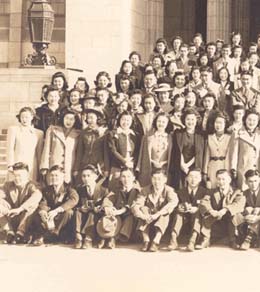
On this day, in Seattle, the University of Washington held a graduation ceremony to honor 450 Japanese American (known as Nikkei) students who were forced to leave the UW for incarceration camps during World War II under President Franklin D. Roosevelt’s Executive Order 9066.
Nearly 200 Nikkei students or their surviving family members attended and received honorary diplomas after a 66-year wait. A crowd of 900 attended the ceremony at UW’s Kane Hall.
May 20, 1968
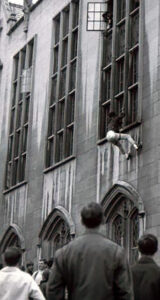
On this day, the University of Washington Black Student Union staged a four-hour sit-in at the UW Administration building. The sit-in resulted in a UW commitment to:
- Double black enrollment
- Increase financial aid
- Introduce Black Studies courses.
May 20, 1972
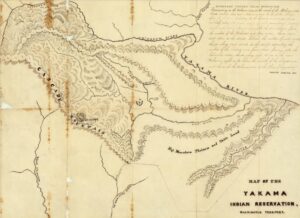
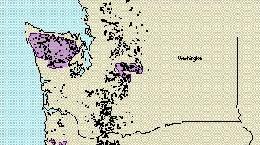
On this day, President Richard M. Nixon signed Executive Order 11670, which directed the Secretary of the Interior to assume jurisdiction over a 21,000-acre tract of land in the Gifford Pinchot National Forest and administer it for the use and benefit of the Yakama Nation as part of the Yakama Reservation in southern Washington.
The land was originally intended to be part of the reservation as created by the Treaty of 1855, but thanks to a misfiled map and sloppy surveys, the United States assumed jurisdiction over the territory in the late nineteenth century. The map with the accurate boundaries was discovered in 1930, but it took 42 more years for the error to be corrected by the president’s executive order.
May 23, 1910
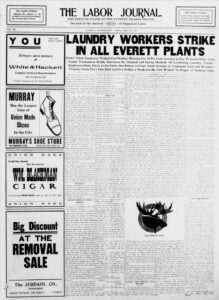
On this day, Everett laundry employees – using the slogan “Twenty Cents for a Shirt and Five Dollars a Week for a Girl Worker” — strike for a pay increase. While laundry prices have increased, managers blame rising labor costs, and workers claim they have not received a pay raise in two years.
No Everett laundry in 1910 recognized the Laundry Workers Union, Local 154, but individual employees were union members and all risk losing their jobs by participating in the walkout.
May 23, 1943
On this day, local activists and community members formed the Bremerton branch of the National Association for the Advancement of Colored People (NAACP). Established in response to segregation and racial tensions in Kitsap County, the group spawned the Carver Civic Club, a social group for African American women.
May 23, 1991
On this day, U.S. District Court Judge William Dwyer blocked timber sales in national forests to protect the northern spotted owl (Strix occidentalis caurina). Dwyer ruled in favor of the National Audubon Society and the Sierra Club Legal Defense Fund, which challenged the U.S. Forest Service’s 1986 Forest Management Plan as inadequate to protect the bird. Dwyer would order the Forest Service to halt more than 75 percent of its planned timber sales — 2 billion board feet — until the agency developed a final plan to protect the threatened species
This post is in partnership with HistoryLink, and Warren Seyler, former chairman Spokane Tribe of Indians, the Black Muse Resource Center, and the Living Arts Cultural Heritage.
We encourage you to engage in further research through your local historic societies, museums, archives, and community.