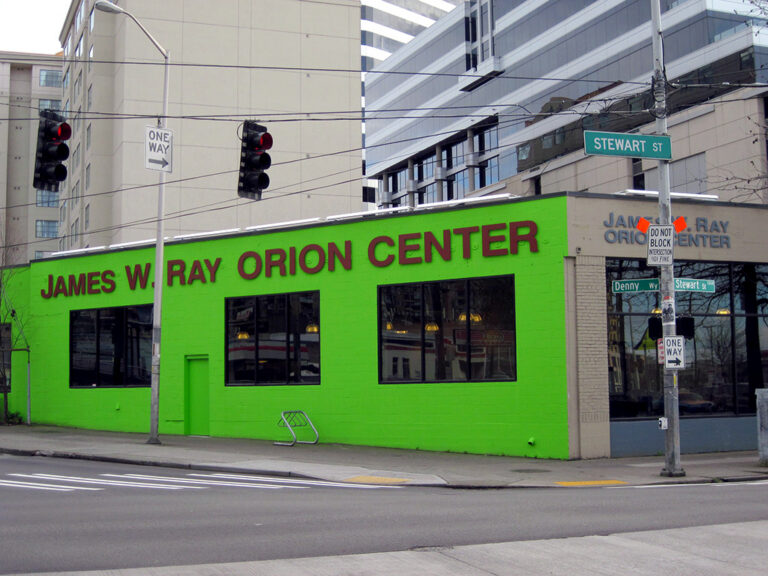
Orion Center, Seattle, January 26, 2010
Courtesy Blanket America
October 12, 1983
On this day, the Orion Multi-Service Center opened in Seattle’s Belltown neighborhood. A safe haven for homeless youth, the center occupied 6,800 square feet in a converted clothing warehouse at 2521 2nd Avenue. The Orion Center, writes The Seattle Times, “will be unique in offering help in one place to walk-ins with a wide variety of problems. Included will be preventative programs, free meals, emergency housing, medical care, alternative education, employment training, legal assistance and pre-natal counseling.”
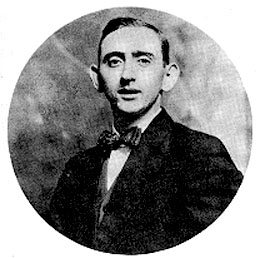
International Longshoremen's Association leader Shelvy Daffron. killed at Point Wells on June 30, 1934
Courtesy Frances Daffron
October 12, 1934
On this day, West Coast longshoremen won a victory in an arbitrated settlement to one of the most important and bitter labor strikes of the twentieth century.
The roughly two-month strike was characterized by violent clashes, including several deaths. President Franklin Roosevelt and the National Labor Board (forerunner of the National Labor Relations Board) arbitrated an end to the strike, which firmly established the rights of waterfront workers nationwide.
The settlement awarded the International Longshoremen’s Association recognition, wage increases, and union control of the waterfront hiring halls.
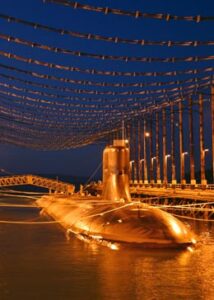
Trident submarine, Naval Base Kitsap -- Bangor, 2008
Courtesy United State Navy
October 13, 1976
On this day, the federal circuit court of appeals for the District of Columbia, in its opinion in Concerned About Trident v. Rumsfeld, ruled unambiguously that even military projects deemed crucial to the nation’s security are not per se exempt from the requirements of the National Environmental Policy Act (NEPA).
The three-judge panel ruled that the navy’s Trident EIS was faulty only in two relatively minor respects — it failed to analyze the environmental impacts that could occur in a reasonable period after the projected completion date in 1981, and it needed further discussion of the alternative systems and their environmental consequences which the navy considered before choosing the Bangor site.
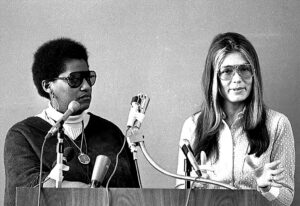
Margaret Sloan (left) and Gloria Steinem, ca. 1976 Courtesy Northern Illinois University
October 13, 1972
On this day, Gloria Steinem arrived in Seattle for a two-day visit full of meetings, lectures, and media interviews. Steinem used her pulpit to call attention to the Equal Rights Amendment, which the U.S. Congress had passed in March 1972 but was awaiting ratification by a mandated 38 states. Although she was met with enthusiastic support, some protestors and hecklers dog her events, and a $10-a-plate dinner sponsored by the Washington State Women’s Political Caucus received a bomb threat. Steinem shared the stage with her friend and Ms. staffer Margaret Sloan, a Black feminist, civil rights advocate, and poet.
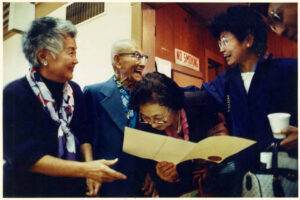
103 year old Kichisaburo Ishimitsu (second from left) and friends at redress ceremony, October 14, 1990 Photo by Michael Urban, Courtesy MOHAI (2000.107.098.20.02)
October 14, 1990
On this day, in Seattle’s Nisei Veterans Hall, the United States government officially apologized to five Japanese Americans, ages 100 and over, who had been unjustly incarcerated during the internment of West Coast Japanese Americans during World War II.
During the ceremony, the five- Harry Nakagawa (100 years old), Kichisaburo Ishimitsu (103), Uta Wakamatsu (102), Shoichiro Katsuno (105), and Frank Yatsu (107)- each received, by way of redress, a $20,000 check as required by the Civil Liberties Act.
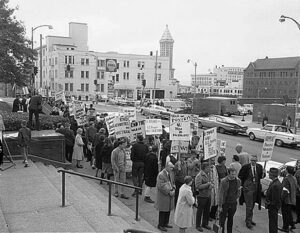
Antiwar Marchers in Downtown Seattle, October 16, 1965 Courtesy MOHAI
October 16, 1965
On this day, between 350 and 400 citizens marched in downtown Seattle to protest the escalating U.S. military involvement in Vietnam. This first major local demonstration against the war was organized by Seattle Committee to End the War in Vietnam (SCEWV) and the University of Washington chapter of Students for a Democratic Society (SDS). Demonstrators marched under police escort down 4th Avenue from the Federal Courthouse at Spring Street to a noon rally at Westlake Mall, where scuffles broke out with hostile spectators.
This post is in partnership with HistoryLink, and Warren Seyler, former chairman Spokane Tribe of Indians, the Black Muse Resource Center, and the Living Arts Cultural Heritage.
We encourage you to engage in further research through your local historic societies, museums, archives, and community.