Week 16: April 20-26
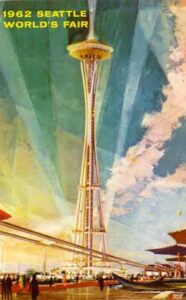
April 21, 1962
On this day, at 11 a.m., the Century 21 World’s Fair opened in Seattle for a 184-day run. The 74-acre fairgrounds are located at Seattle Center, north of downtown Seattle at the foot of Queen Anne Hill. The World’s Fair was conceived to celebrate the 50th Anniversary of the Alaska-Yukon-Pacific Exposition, held in 1909 on the University of Washington campus. Its theme was to consider the possibilities of life in the twenty-first century.
April 22, 1936
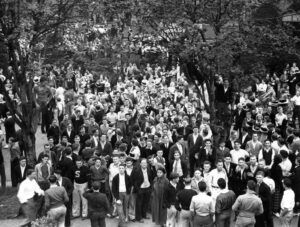
On this day, at 11 a.m., about 500 students walked out of class at Lincoln High School in Tacoma. Chanting slogans, they marched through the 38th Street business district and down Tacoma Avenue to crosstown rival Stadium High, two and a half miles away. Another 200 or so students rallied at Pacific Lutheran College (now University) in a separate demonstration, while students at the College (now University) of Puget Sound met indoors to pass resolutions in favor of peace.
The Tacoma protesters were among an estimated 400,000 students demonstrating nationwide in the second year of a student movement protesting global militarization. Although the demonstrations in Tacoma were peaceful, their aftermath would include arrests, fines, and legal wrangling for some Lincoln students and their supporters.
April 22, 1970
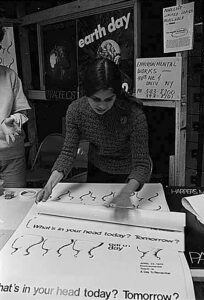
On this day, the first Earth Day, a nationwide program to spend one day considering issues of environmental protection, was observed in Seattle with teach-ins at the University of Washington and at the Seattle Center.
A noon rally at Westlake Mall drew only 50 or so participants, but later that evening, some 3,000 persons crowded together at Seattle Center to look at exhibit booths, view films, listen to speeches and panel discussions, and to collect signatures and money. Seattle Mayor Wes Uhlman challenged the audience to go to the next demonstration in buses instead of in private cars, to fight pollution.
April 22, 1989
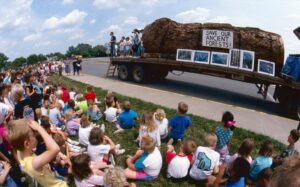
On this day, the Ancient Forest Rescue Expedition launched from Pike Place Market. Mitch Friedman, a young environmentalist, gave a speech to a crowd calling for a slowdown of the logging of the Northwest’s old-growth forests. The expedition would tour the United States with a truck and flatbed trailer carrying a 731-year-old Douglas fir log to educate a curious public. The spectacle of a Northwest log being shown around the nation would attract attention to old-growth logging controversies and help nationalize the issue. The expedition, supported by dozens of organizations and donations, stopped in 44 states during its successful monthlong journey before ending its tour in Portland, Oregon.
April 22, 2010
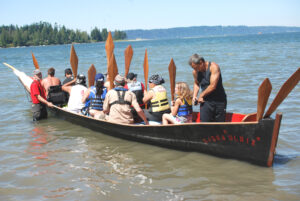
On this day, the Snoqualmie Tribe held a blessing ceremony at Lake Sammamish State Park for the Northern Dipper, its newly built ocean-going canoe. The canoe would be used that summer during Canoe Journey 2010, the Paddle to Makah. Members of the Snoqualmie Tribe have been involved in the annual Canoe Journeys since 1989, when Emmett Oliver led the first journey as part of Washington’s centennial celebrations.
The Snoqualmie Tribe established its first canoe family in about 2000, bringing together tribal members who worked together to revive cultural practices, including canoe carving, learning traditional songs, weaving, speaking Lushootseed, and, of course, paddling canoes on rivers and the open water of the Salish Sea. Due to a lack of cedar logs of suitable size, the Northern Dipper was a cedar-strip canoe, while others have been dugout canoes.
This post is in partnership with HistoryLink, and Warren Seyler, former chairman Spokane Tribe of Indians, the Black Muse Resource Center, and the Living Arts Cultural Heritage.
We encourage you to engage in further research through your local historic societies, museums, archives, and community.