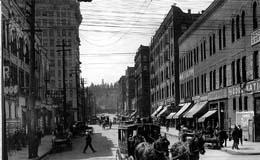
Stevens Street, looking south from Main Avenue, Spokane, ca. 1910
Photo by Wylie J. Dennison, Courtesy UW Special Collections (5344)
November 2, 1909
On this day, the Industrial Workers of the World (IWW or Wobblies) formally began the Spokane free-speech fight. This was a civil disobedience action mounted in public defiance of a Spokane City Council ordinance banning speaking on the streets. One by one, IWW members mounted a soapbox (an overturned crate) and began speaking, upon which Spokane police yanked them off the box and took them to jail. On the first day, 103 Wobblies are arrested, beaten, and incarcerated. Within a month, arrests will mount to 500. The Spokane free-speech fight is considered one of the most significant battles to protect freedom of speech in American history.
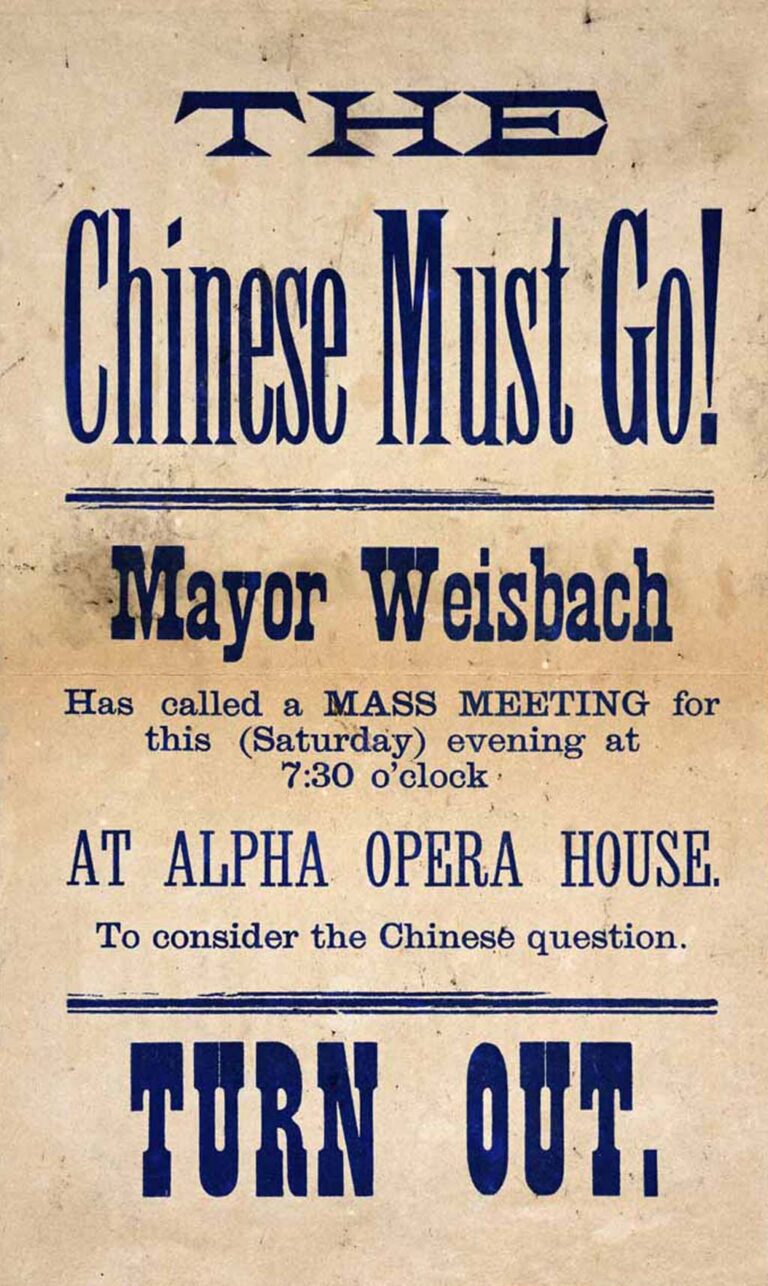
Poster calling for expulsion of Chinese residents, Tacoma, 1885 Courtesy Washington State Historical Society (Image 1903.1.4)
November 3, 1885
On this day, a mob, including many of Tacoma’s leading citizens, marched on the city’s Chinese community and forced everyone out of their houses and out of town. The Tacoma Ledger and its editor Jack Comerford, the carpenters’ union, the mayor, and many workers and business people have spewed racist rhetoric against the Chinese for months. The Chinese community was given a deadline to leave by November 3. In reaction to the threats, about 150 frightened Chinese people left Tacoma before the deadline. The mob herds another 200 out on November 3. They lost their homes and most of their possessions, and they never returned. More than a century later, in 1993, the Tacoma City Council passed a resolution to make amends and to apologize for the former city leaders’ actions.
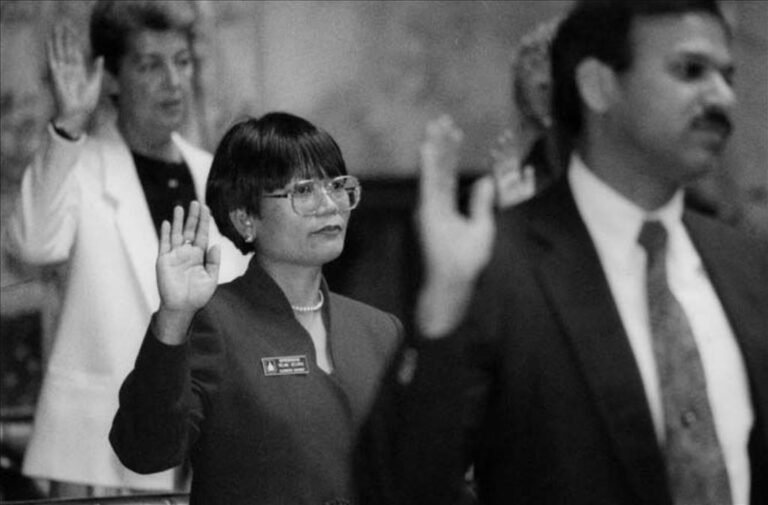
Velma Veloria taking oath of office at Washington State House of Representatives, Olympia, January 11, 1993 Photograph by Michael Urban for the Seattle Post-Intelligencer, courtesy MOHAI (2000.107.219.31.01)
November 3, 1992
On this day, Velma Veloria was elected to the Washington State Legislature. She is the first Filipina elected to a state legislature in the continental United States. She would serve for 12 years as State Representative for Southeast Seattle’s 11th District.
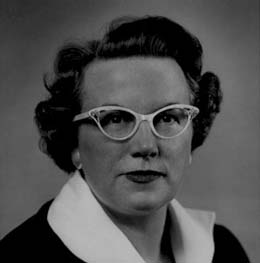
Catherine Dean Barnes May (1914-2001), ca. 1960
Courtesy Washington Women's History Consortium
November 4, 1958
On this day, Yakima state legislator Catherine May was elected to the United States House of Representatives, becoming the first woman to represent Washington state in Congress. One of the few women of her generation to win election to national office without first being appointed to replace a husband, May served 12 years in Congress before being defeated in her bid for a seventh term in 1970.
On this day, Washington voters made history as the state became one of the first three to enact marriage equality by popular vote, and one of two to legalize recreational marijuana use by adults. President Barack Obama won the state by a wide margin on his way to re-election over Republican challenger Mitt Romney. Democratic U.S. Representative Jay Inslee defeated Republican Attorney General Rob McKenna to win the governor’s mansion vacated after two terms by Democrat Chris Gregoire. Democratic U.S. Senator Maria Cantwell won a third term by a landslide, seven incumbents were easily re-elected to the U.S. House of Representatives, and Democrats Suzan DelBen, Derek Kilmer, and Denny Heck won the state’s three open U.S. House seats.
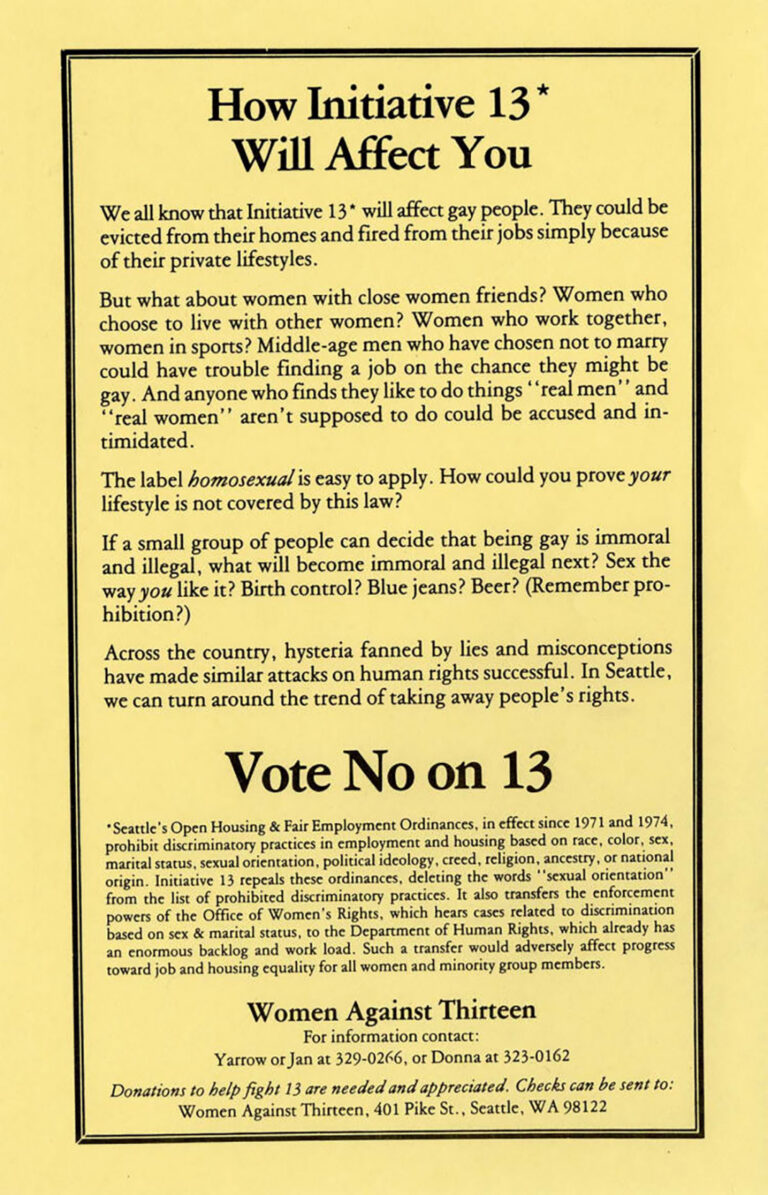
Leaflet persuading voters to vote "No" on Initiative 13, 1978 Courtesy UW Special Collections (PNW04211)
November 7, 1978
On this day, Seattle voters rejected Initiative 13 decisively, by nearly two to one. Initiative 13 would have repealed city ordinances protecting employment and housing rights for gays and lesbians. Also, it would have dissolved the City of Seattle’s Office of Women’s Rights.
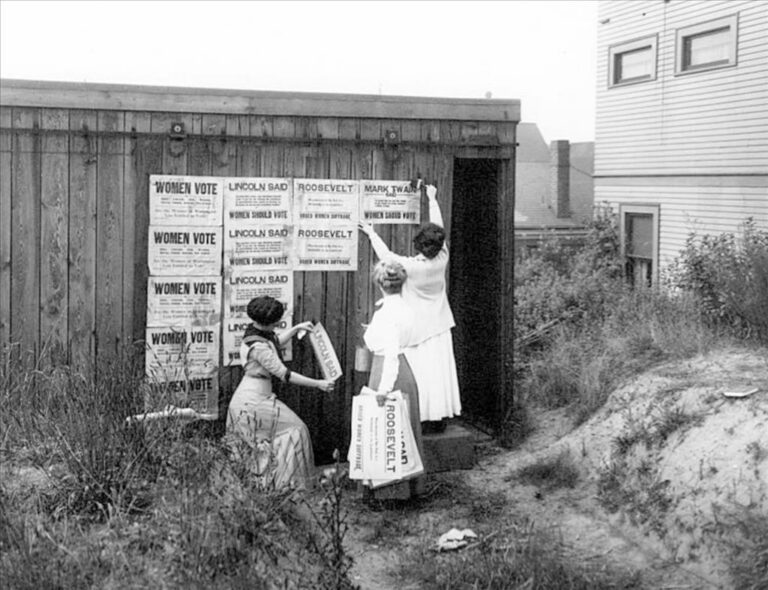
Posting signs to promote woman suffrage, Washington Equal Suffrage Association, Seattle, ca. 1910 Photograph by Asahel Curtis, courtesy UW Special Collections (CUR10)
November 8, 1910
On this day, Washington state’s male electorate ratified Amendment 6 to the state constitution, granting women the right to vote. Breaking a 14-year gridlock in the national woman suffrage crusade, the state became the fifth in the nation to enfranchise women. Two outstanding women led the Washington crusade: Emma Smith DeVoe of Tacoma and May Arkwright Hutton of Spokane. DeVoe was a paid organizer for the National American Woman Suffrage Association and president of the Washington Equal Suffrage Association. Hutton, a wealthy mine owner and philanthropist, spearheaded the efforts of Eastern Washington and was one of the most influential suffrage leaders on the state level.
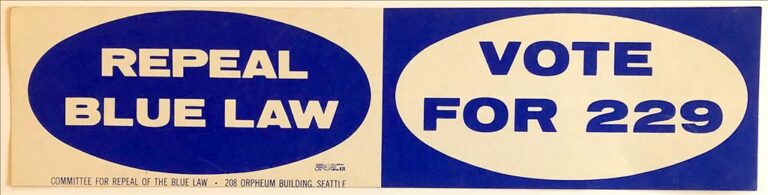
Bumper sticker urging voters to vote for Initiative 229 to repeal the Blue Law, Washington state, 1966 Courtesy Peter Blecha collection
November 8, 1966
On this day, in the Washington state general election, voters adopted Initiative 229, repealing the so-called Blue Law, which had been enacted in 1909. This action legalized the operations of thousands of businesses in the state that had been opening on Sunday in violation of that law, and eliminated the legal bias favoring religions whose day of worship was Sunday. It did not legalize, but ultimately led to the sale of liquor on Sunday in the state.
This post is in partnership with HistoryLink, and Warren Seyler, former chairman Spokane Tribe of Indians, the Black Muse Resource Center, and the Living Arts Cultural Heritage.
We encourage you to engage in further research through your local historic societies, museums, archives, and community.