Week 17: April 27 - May 3
April 29, 2002
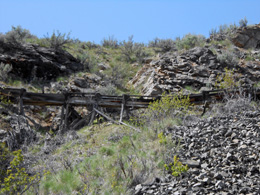
On this day, the Washington State Department of Ecology ordered the Methow Valley Irrigation District to protect endangered fish by reducing its diversion of water from the Methow and Twisp rivers.
Part of a long-running dispute, the order required the district to curtail its diversion rate from both rivers to levels far below its previous diversion amounts. The order was based on the finding that the district has engaged in “wasteful diversion and use of water during low water years,” negatively affecting “aquatic resources of significant importance to the State of Washington” (Order No. DE O2WRCR-3950).
April 29, 2011
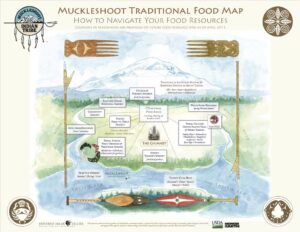
On this day, participants in the Muckleshoot Food Sovereignty Project planted an orchard at the Muckleshoot Tribal School in Auburn. Valerie Segrest and other program staff worked with students to plant fruit trees as part of a multi-year project to create a cultural program to improve the health of the Muckleshoot people by revitalizing and increasing access to their traditional foods.
The project began by engaging the tribal community in an assessment of food resources, then integrated those findings in a community-based art project, the Muckleshoot Traditional Food Map. The map would be used as a reference for building a more secure and culturally appropriate food system and as a guide for future projects.
April 29, 2020
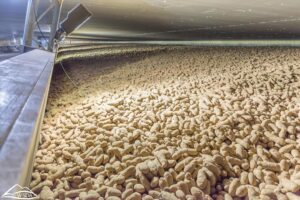
On this day, volunteers handed out free potatoes in a drive-through giveaway that caused a rare traffic jam in the small Eastern Washington city of Ritzville in Adams County. The distribution of nearly 20 tons of potatoes donated by the Wollman family, which operates the Hutterian Brethren Farm near Warden in Grant County, marked the start of efforts by Washington potato growers and the Washington State Potato Commission to donate a million pounds of surplus potatoes during the COVID-19 pandemic and resulting economic crisis. Ordinarily, the vast majority of potatoes grown in Washington are processed into french fries used in restaurants around the world. With restaurants across the globe closed as a result of efforts to slow the spread of COVID-19, demand for potatoes plummeted, and Washington growers were left with tons of potatoes and nowhere to sell them.
May 1, 1896
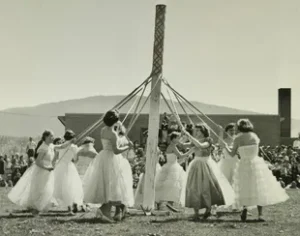
On this day, local farm families celebrated their completion of the first irrigation ditch carrying Dungeness River water to Sequim Prairie. Located in eastern Clallam County in the rain shadow of the Olympic Mountains, the fertile prairie receives less than 17 inches of rain a year. Dug by hand by local farmers who organized the Sequim Prairie Ditch Company in 1895, the ditch marked the beginning of the Sequim Irrigation District. Over the next quarter-century, some 20 ditch companies construct a maze of canals throughout the Dungeness Valley, eventually creating a 25,000-acre canal-sprinkler irrigation system, the largest in Western Washington. The Sequim Irrigation Festival commemorating the opening of the first ditch has been held every year since 1896, making it the oldest continuing festival in the state.
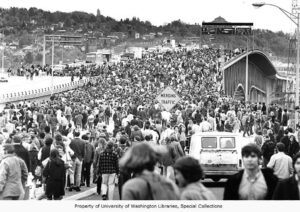
May 1, 1970
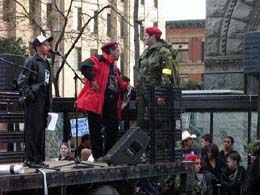
On this day, protests erupted in Seattle following the announcement of President Richard M. Nixon that U.S. Forces in Vietnam would pursue enemy troops into Cambodia, a neutral country. The focus of protest activity was the University of Washington, but anti-war protests and disruptions also swept downtown. Student strikers dominated the campus radio station and newspaper, and Seattle police were accused of using excessive force.
May 1, 2006
On this day, thousands of people marched the streets of Seattle and Yakima in support of immigrants’ rights in some of the largest marches in recent history.
The march, characterized as “the day without immigrants,” was coordinated by immigrants’ rights proponents from various sectors of the community, including faith-based organizations, organized labor, human rights groups, and students at college and high school levels. The event coincided with International Workers’ Day as a symbolic gesture of solidarity with immigrant workers and their families throughout the United States.
May 2, 1922
On this day, women are elected for the first time to the Seattle City Council. The two women elected are Bertha Knight Landes, who won 80 percent of the vote and later served a term as Seattle mayor, and Kathryn Miracle.
Miracle had come to Seattle 16 years before. She said: “I stand for a progressive platform. I shall take a firm stand for a five-cent car fare.”
This post is in partnership with HistoryLink, and Warren Seyler, former chairman Spokane Tribe of Indians, the Black Muse Resource Center, and the Living Arts Cultural Heritage.
We encourage you to engage in further research through your local historic societies, museums, archives, and community.