
Washington Masonic Library & Museum (Out of Many, One display)
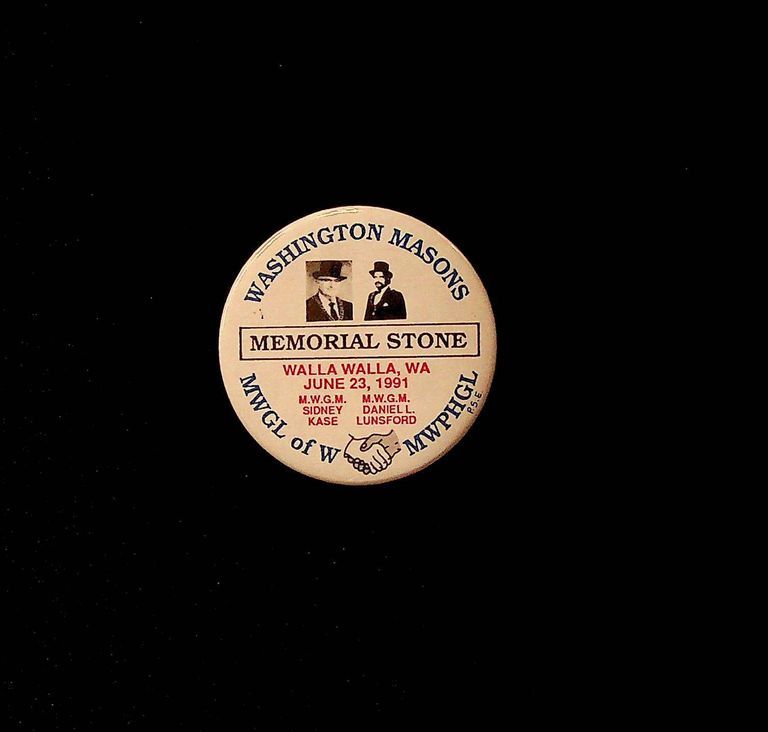
Button: Commemorating a Memorial Stone for William H. Upton (1991)
“Let Justice Prevail Though the Heavens Fall”
In 1898, Washington was the first Grand Lodge in the United States to pass a resolution which allowed its Lodges to recognize Prince Hall Masons, an action that consumed William H. Upton’s year as Grand Master (1898-1899), and raised important questions about who could be acknowledged as Freemasons in both Washington and the entire United States.
The origins of Prince Hall Masonry date back to 1775 in Boston, Massachusetts. After being rejected from joining every Masonic Lodge in the city, a free Black man named Prince Hall and fourteen other African Americans were welcomed into a British Military Lodge. Shortly after the American Revolution, Hall founded African Lodge No. 459 with permission from the Grand Lodge of England. From then on, Prince Hall Masonry began spreading throughout the United States as more African Americans wished to join the fraternity. Yet, due to ongoing discrimination, no other American Grand Lodge would recognize them as legitimate Freemasons.
In 1897, two members of Prince Hall who had settled in Washington (Brothers Gideon Bailey and Con Rideout) petitioned Washington Grand Lodge asking for a way in which they could communicate with and confide in them as fraternal Brothers. William H. Upton led a Grand Lodge Committee to review the matter. As a lawyer and a careful study of the history of Freemasonry, Upton considered the circumstances of Prince Hall’s creation and wrote a thorough report on behalf of the committee, recommending that Grand Lodge acknowledge Prince Hall Masonry. The resolution was approved in 1898, the same year Upton was elected Grand Master.
However, this decision led to intense backlash throughout the United States, and ultimately fifteen Grand Lodges throughout the country withdrew their recognition of Washington. This meant that Washington Masons would not be treated as legitimate Masons in these states and could not communicate or join Lodge meetings with them until Washington rescinded this resolution. This was the highest level of censorship one Grand Lodge could bestow on another.
The heat on Washington Grand Lodge was intense, and Upton spent his year as Grand Master answering letters of criticism from all over the country regarding this decision. During the next year’s annual communication, Upton used his Grand Master’s address to lay out a lengthy rebuttal to each argument from other jurisdictions against accepting Prince Hall Masonry as legitimate. Ultimately, the decision to rescind the previous year’s resolution was held to a vote, and the Masons of Washington decided to do so, much to Upton’s dismay.
In Upton’s will, he instructed that “nothing but the most simple headstone should mark his last resting place” until such time as both his Grand Lodge and Prince Hall Masons could come together as Brothers. It was not until the 1980s and 1990s that other Grand Lodges around the United States began acknowledging Prince Hall Masonry. Washington Grand Lodge officially re-recognized Prince Hall at their 1990 Annual Communication. Prince Hall Grand Lodge also voted to recognize Washington Grand Lodge that same year.
On June 8, 1991, a joint congregation of the Most Worshipful Prince Hall Grand Lodge of Washington and the Most Worshipful Grand Lodge of Washington laid a memorial stone for William H. Upton in Walla Walla. Grand Orator John D. Keliher gave a moving speech in which he said, “Upton spent his year defending what everyone valued in the abstract and few practiced in the concrete…At his death he forbade the Grand Lodge to honor him with a ceremony or stone until we could meet here today, as men, as women, as children of a common God, Masons all.”
He went on to say, “Over the lintel of the doorway of the courthouse in which Upton presided was the chiseled statement, “Let Justice Prevail Though the Heavens Fall.” One man in the right, one man claiming justice and proclaiming truth constitute an absolute majority even on a day when they may be a minority.”
This button commemorates that moment in time in which the two Grand Lodges of Washington were finally able to come together, recognizing each other as Brothers and remembering the man who started that journey almost a century earlier.
How it represents the community’s American experience:
“We the People, We the Freemasons”
This button represents a full circle moment on a decision to stand for equality, despite an intensity of criticism steeped in larger social forces of discrimination. Freemasonry has three tenets: Brotherly Love, Relief, and Truth. When the Grand Lodge of Washington chose to pass this resolution, they were trying to uphold those tenets to the best of their ability. Yet, they were also living in a time when making this choice to fight for equality in Washington Freemasonry created intense scrutiny from around the United States. At the time, not every Mason in this state was ready to accept that.
This moment in 1991 allowed Washington Grand Lodge and Prince Hall Washington Grand Lodge to come together at Upton’s gravesite and move forward acknowledging one another as Brothers. Every year since, both Grand Lodges meet for a Unity March in honor of this decision.
On display at the Steilacoom Historical Museum, Saturday – Sunday, 1 – 5 p.m., April 17 – September 17, 2026.