
Museum of Pop Culture “MOPOP” (Out of Many, One display)
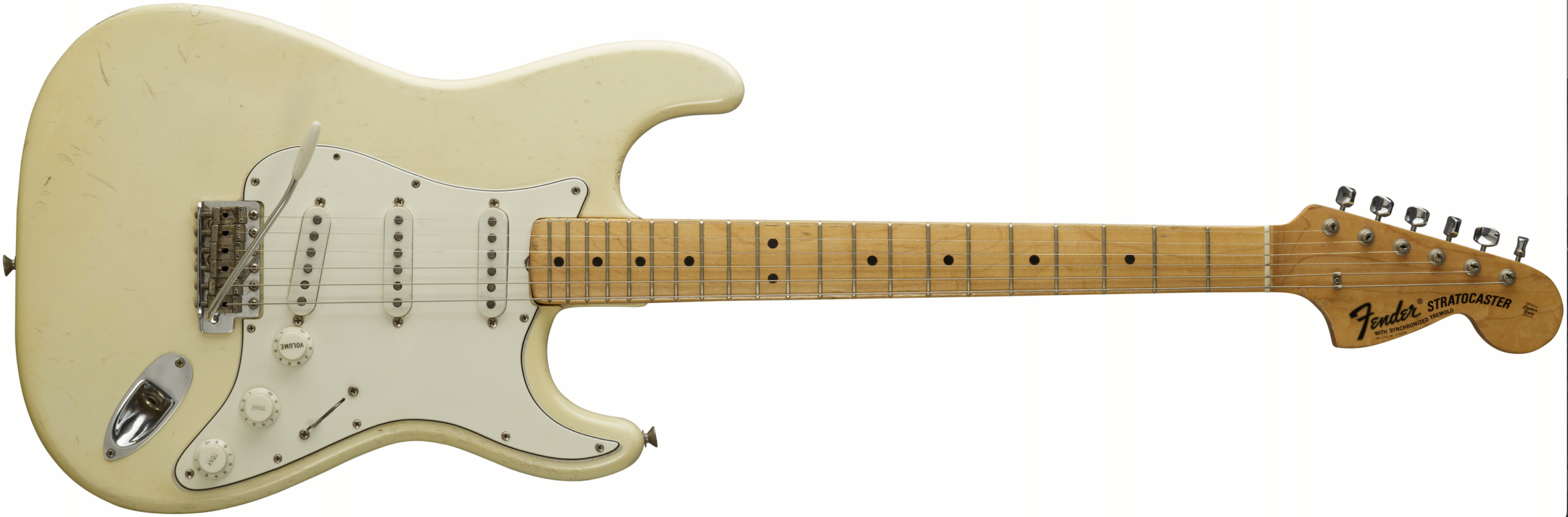
Fender Stratocaster Electric Guitar Formerly Owned by Jimi Hendrix and Played at Woodstock Music & Art Fair in 1969
Jimi Hendrix (1942-1970) was an American musician in the late 1960s known for singing, songwriting, and as one of the most influential guitarists of all time known for iconic hits including “All Along the Watchtower”, “Purple Haze”, “Voodoo Child (Slight Return)”, “Foxy Lady”, and more. The item featured is a Fender Stratocaster Electric Guitar Formerly Owned by Jimi Hendrix and Played at Woodstock Music & Art Fair in 1969.
This Stratocaster is a right-handed electric guitar with an Olympic White finish, white pickguard, white knobs, maple neck, chrome tuners, input jack, bridge and tremolo bar. It was originally purchased new by Jimi Hendrix in late 1968 from Manny’s Music in New York City and was used in several shows from October 1968 through his passing in September 1970. The most notable performance this guitar was used for was Hendrix’s historic rendition of “The Star-Spangled Banner” at the Woodstock Music and Arts Fair in Bethel, New York on August 18, 1969.
Famously a left-handed guitar player, Hendrix made modifications to the Stratocaster including reversing the order of the strings and bone nut near the headstock; switching the position of the strap pin from the longer horn to the shorter horn; and playing the guitar upside-down to fit his left-handed playing. These adaptations, born of necessity, became a hallmark of his musical identity and significantly contributed to the tonal differences that distinguished his sound from other guitarists at the time.
Despite Hendrix’s aggressive playing style, damage to this Stratocaster is limited to worn finish on the headstock near where the strings attach (where he may have placed a cigarette during performances) and small indentations along the body (potentially from his rings). In addition to changing music history, this was the last guitar he played with the Jimi Hendrix Experience group, at his last Seattle concert at Sick’s Stadium in July of 1970, and the last guitar he ever played in concert.
Shortly before his death on September 18, 1970, Hendrix gifted the guitar to Mitch Mitchell (1946-2008), drummer for the Jimi Hendrix Experience.
How it represents the community’s American experience:
On Monday morning of the 1969 Woodstock Music & Art Fair, Jimi Hendrix made history with his free-form and distorted rendition of “The Star-Spangled Banner,” a cornerstone symbol of patriotism that he transformed into a bold political and artistic statement. Hendrix performed at the close of the festival for a generation grappling with the Vietnam War, civil rights struggles, and political unrest.
By incorporating the innovative techniques of amplifier feedback, heavy distortion, the whammy bar, and pedals, Jimi Hendrix produced sounds on the Stratocaster that resembled sirens, explosions, and falling bombs. This performance served as a powerful commentary on the Vietnam War, racial injustice, and political division. Hendrix also incorporated a brief, haunting rendition of “Taps,” a bugle call used by the U.S. military to honor deceased service members, into his performance as a tribute to soldiers amid a chaotic, distorted interpretation of the national anthem.
Jimi Hendrix’s performance expanded and reinterpreted the national anthem and illustrated the fluidity of American identity and how it is continually reshaped through free expression, patriotism, and protest. His performance demonstrates the power of art and music’s to unify people and has since become emblematic of the cultural shift in the late 1960s in which youth activism, civil rights movements, and anti-Vietnam War movements reshaped national dialogue, asserting that dissent, artistic experimentation, and protest are themselves central to the American experience.
On display at the Museum of Pop Culture (MOPOP), daily 10 a.m.–5 p.m. Featured in the Wild Blue Angel: Hendrix Abroad, 1966-70 exhibit until May 2026, then will be moved to the Rebels + Icons: The Photography of Janette Beckman exhibit.