
Fort Walla Walla Museum (Out of Many, One display)
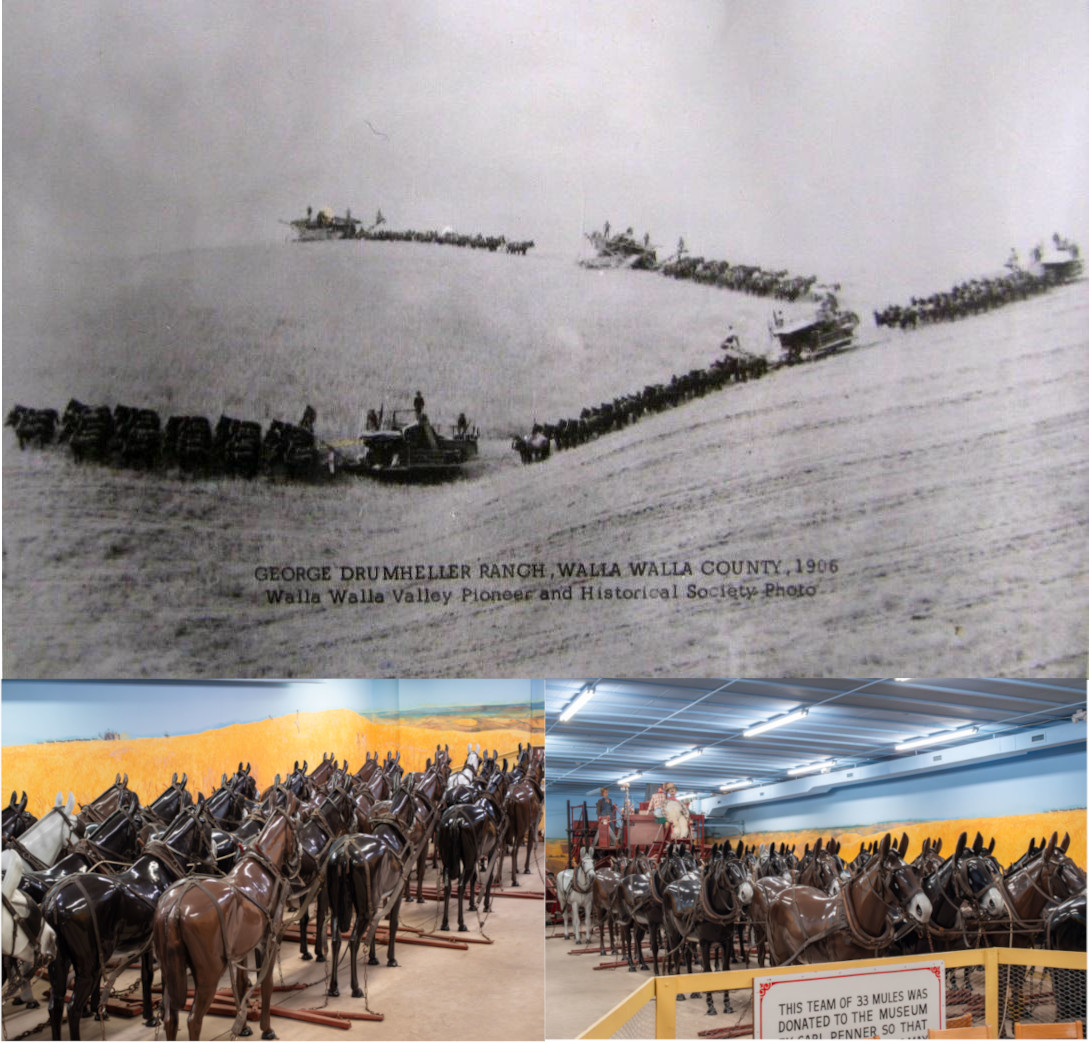
Harris Combine with 33 Mule Team
Agriculture has always been a pillar of U.S. culture and economy, and Walla Walla grew a large amount of that wheat. The combine and mule team made large-scale wheat production possible. With the advent of the combine, a wheat harvest crew of five men could do what previously took 20 or more. A muleskinner drove the combine with reins connected just to the animals at the very front, while a sack jig filled sacks from the grain spout for the sack sewer to sew shut, the header puncher kept the header even with the ground, and the machine man operated the leveling mechanism and ensured all the machinery worked. The entire team of mules always had to be fed, watered, and cared for ahead of the crew. Each machine harvested roughly 30 acres per day. Larger farms had multiple combines harvesting at once.
This 1919 Harris combine is displayed with life-sized crew and 33-mule team surrounded by a mural of a harvest on the Palouse Hills. While fertile, these hills posed a challenge to farmers. In order to harvest on such slopes, farmers outfitted the combine with hill-side leveling technology. The combine was pulled using a Shandoney Hitch that equalized the workload for each of the 33 mules required to pull this machine through the fields up the steep grades. Wooden combines pulled by mule teams remained generally in use well into the 1930s until most farmers replaced their animals with tractors.
The founders of Fort Walla Walla Museum knew that a dedicated building and life-sized display was needed to give an inkling of the true scale of what it took to farm wheat and transform this region. This combine represents the fusion of animal and machine, grit and innovation that defined the farmers who built Walla Walla’s agricultural legacy – and helped feed the nation and the world.
How it represents the community’s American experience:
Because of the large amount of wheat grown here, the Walla Walla region was once known as the breadbasket of the world. Harvests on the slopes of Palouse Hills were facilitated by a hill-side leveling technology built into this wooden combine, drawn of 33 mules. It was the technique of dryland farming brought by immigrants, combined with this hill-side leveling technology, that made Walla Walla the region’s breadbasket known for its wheat exports. Various communities settled in the Walla Walla region to farm, many of which still make up the community today. Italians, Germans, and large numbers of Seventh-day Adventists all settled in the Walla Walla Valley and helped to create a region known for its agriculture.
The Harris Combine and its 33 Mule team are a visual representation of the ingenuity of the community that settled in this region. Both adaptive and resourceful, the farmers who used these 33 mule teams are examples of a diverse community that worked together and continues to do so today.
On display at the Fort Walla Walla Museum, 10 a.m. – 5 p.m. March –October, and 10 a.m. – 4 p.m. November – February.