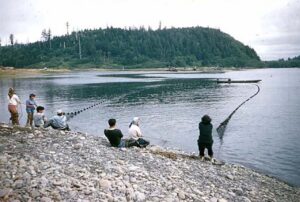
Quileute Tribe members set fishing net, La Push, ca. 1955 Photo by J.W. Thompson, Courtesy MOHAI (2004.43.1382)
June 24, 1974
On this day, a charter committee met in Seattle to develop a constitution for the Northwest Indian Fisheries Commission. The charter committee was formed in response to the tribes’ new role as co-managers of treaty area fisheries, one result of the case U.S. v. Washington (commonly known as the Boldt decision). The committee envisioned the organization as a way to share tribal financial resources, more efficiently develop fisheries management programs, offer a forum for the tribes to discuss policy and coordinated actions, and improve public understanding of Indian cultures and treaty rights. The commission would support the tribes’ ongoing efforts to develop working relationships with state agencies and other non-Indians, protect their treaty rights, and restore Western Washington fisheries.
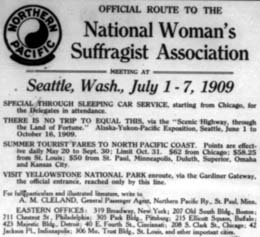
Northern Pacific Railroad's advertisement in Progress Magazine for Suffrage Special train taking delegates to July 1909 National American Woman Suffrage Convention in Seattle, March 1909
Courtesy Progress
June 28, 1909
On this day, at 10:00 a.m., a Northern Pacific Railroad train, dubbed the Suffrage Special, carrying suffragists en route to the National American Woman Suffrage Association convention in Seattle arrived at the Northern Pacific Depot in Spokane.
The Suffrage Special carried 37 presidents of state suffrage associations from around the country. Between Spokane and Seattle their train made whistle stops in Pasco, North Yakima (now Yakima), and Ellensburg. At each stop, stars of the suffrage movement addressed the crowds gathered from the train’s rear platform, enlisting the support of Washington’s male voters and their female family members for the upcoming vote to amend the state constitution and grant women the right to vote.
This post is in partnership with HistoryLink, and Warren Seyler, former chairman Spokane Tribe of Indians, the Black Muse Resource Center, and the Living Arts Cultural Heritage.
We encourage you to engage in further research through your local historic societies, museums, archives, and community.