Week 18: May 4-10
May 4, 1974
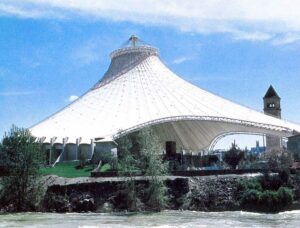
On this day, President Richard M. Nixon presided over the opening of Expo ’74, Spokane’s World’s Fair. Addressing a crowd of 85,000 — including a few hecklers — Nixon says he is most impressed “that the idea did not come from Washington D.C., but from Washington state.” As he formally declared Expo ’74 open, 50,000 balloons were released into the sky.
Spokane, with a population of about 170,000, was the smallest city ever to host a world’s fair. Spokane organizers conceived of the fair as a way to revamp the city’s railroad-choked riverfront and restore public access to the spectacular Spokane Falls of the Spokane River. Expo ’74’s theme was the environment, and many of the 10 international pavilions were about ecological problems and solutions.
May 1955
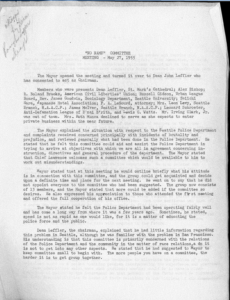
Beginning in May, Seattle Mayor Allan Pomeroy appointed the Mayor’s Advisory Committee on Police Practices to investigate charges of police brutality. The committee issues a harsh indictment of police practices in the predominantly black Central Area neighborhood.
As Quintard Taylor writes in The Forging of a Black Community, the Committee’s findings declared “that the Seattle Police Department — like the white community — held essentially racist attitudes about black citizens, frequently stereotyping them as ‘criminal types.'”
May 8, 1970
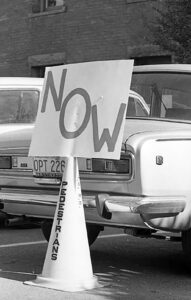
On this day, the Seattle chapter of the National Organization for Women (NOW) was chartered in the chambers of King County Superior Court Judge Evangeline Starr. NOW was a civil rights organization pledged to work actively to bring women into full participation in the mainstream of American society. The 13 founding members included Zelda Boulanger, who was appointed the chapter president.
May 9, 1934
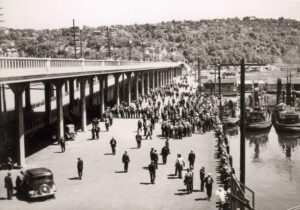
On this day, 1,500 Seattle Longshoremen joined 12,500 other maritime workers in closing every seaport between San Diego and Juneau. It was the first industry-wide strike on the West Coast.
The strike came after steamship companies refused to negotiate with the Longshoremen over issues including representation by the International Longshoremen’s Union, a union-controlled hiring hall, closed shops (all employees are represented by one union), higher wages, and shorter hours.
This post is in partnership with HistoryLink, and Warren Seyler, former chairman Spokane Tribe of Indians, the Black Muse Resource Center, and the Living Arts Cultural Heritage.
We encourage you to engage in further research through your local historic societies, museums, archives, and community.