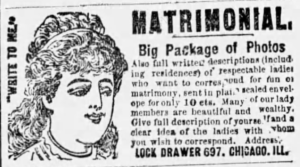
Matrimonial bureau advertises in The Preston Plain Dealer of Preston, Kansas on October 18, 1889.
September 1, 2002
On this day, a Washington State Senate bill regulating the so-called “Mail Order Bride” industry became law. The bill responded to concerns that International Matchmaking Organizations (IMOs), which import women from impoverished countries to marry men from the United States and elsewhere, engaged in widespread human trafficking. The bill, in gender-neutral language, requires IMOs doing business in Washington state to notify foreign nationals in their native language that they have a right to request a criminal background check and marital history information on Washington clients. The IMOs are then required to provide that information upon request. The bill is passed following the murders of two “mail-order brides” by their husbands, among other cases of exploitation and abuse.
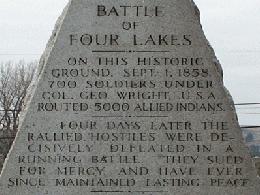
Monument at site of Battle of Four Lakes. The figure "5,000" allied Indians is wildly exaggerated. The actual number of Indians in the battle was fewer than 500.
Courtesy Spokane Outdoors
September 1, 1858
On this day, some 500 U.S. Army troops under Colonel George Wright defeated somewhat fewer than 500 Native Americans at Four Lakes near what would become Spokane. Wright was engaged in a punitive military expedition against the Yakama, Palouse, Spokane, and Coeur d’Alene tribes after their defeat of a force under Lieutenant Colonel Edward Steptoe in May. Unlike Steptoe’s soldiers, Wright’s forces were armed with long-range rifles firing newly developed minié balls. Warriors attacked Wright’s camp, and he counterattacked. The battle lasted four hours, and the Native Americans were driven off with heavy losses.
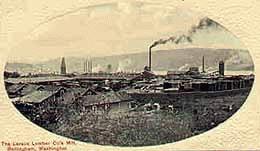
On this night, about 500 white workingmen attacked Bellingham’s East Indian millworkers. The purpose of this “anti-Hindu riot,” according to the Bellingham Reveille, was to “move [the Indian workers] on, to get them out of town, and scare them so badly that they will not crowd white labor out of the mills” (September 5, 1907).
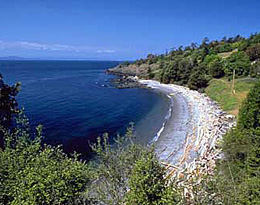
Deadman Bay Preserve, San Juan Island
Photo by Steve Horn, Courtesy San Juan County Land Bank
September 5, 1990
On this day, the San Juan County Board of County Commissioners approved Ordinance No. 142-1990, creating a land bank to conserve natural areas in the county, whose small land area is scattered across dozens of scenic islands in Northwest Washington.
As car ferries and air transport made the islands more accessible, San Juan County’s scenic waterways, open landscapes, and rural lifestyle attracted more and more visitors and residents. But that very popularity endangered the scenery, natural areas, and recreational opportunities that drew people to the islands and boosted their economy.
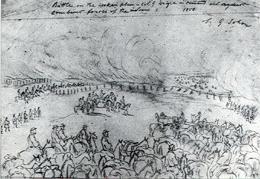
Battle of Spokane Plains, September 5, 1858
Sketch by Gustavus Sohon, Courtesy Washington State University Library
September 5, 1858
On this day, U.S. Army soldiers under Colonel George Wright defeated Native Americans at the Battle of Spokane Plains. The engagement follows a skirmish four days before with members of the Spokane, Palouse, Yakama, and Coeur d’Alene tribes at Four Lakes. The soldiers and the warriors fight over a distance of 14 miles.
The battle began during a march from Four Lakes by the soldiers.
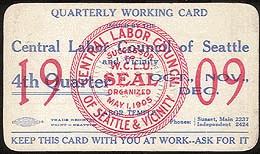
Central Labor Council union card, Seattle, 1909
Courtesy Les Albright
September 6, 1909
On this day, Labor Day 1909, a crowd of more than 12,000 union members and their supporters paraded through downtown Seattle. Each profession carried placards announcing its affiliation, and many had floats that demonstrated their expertise. Workers focused their opposition on the Alaska-Yukon-Pacific (A-Y-P) Exposition Company. The A-Y-P had, in the previous two years, built several new buildings. Labor leaders chastised exposition management for allowing an open shop, meaning non-union labor could be hired. Although the contractors hired many union members, the open-shop policy antagonized unions, which called for a boycott of the fair when it opened.
This post is in partnership with HistoryLink, and Warren Seyler, former chairman Spokane Tribe of Indians, the Black Muse Resource Center, and the Living Arts Cultural Heritage.
We encourage you to engage in further research through your local historic societies, museums, archives, and community.