
- This event has passed.
Out of Many, One
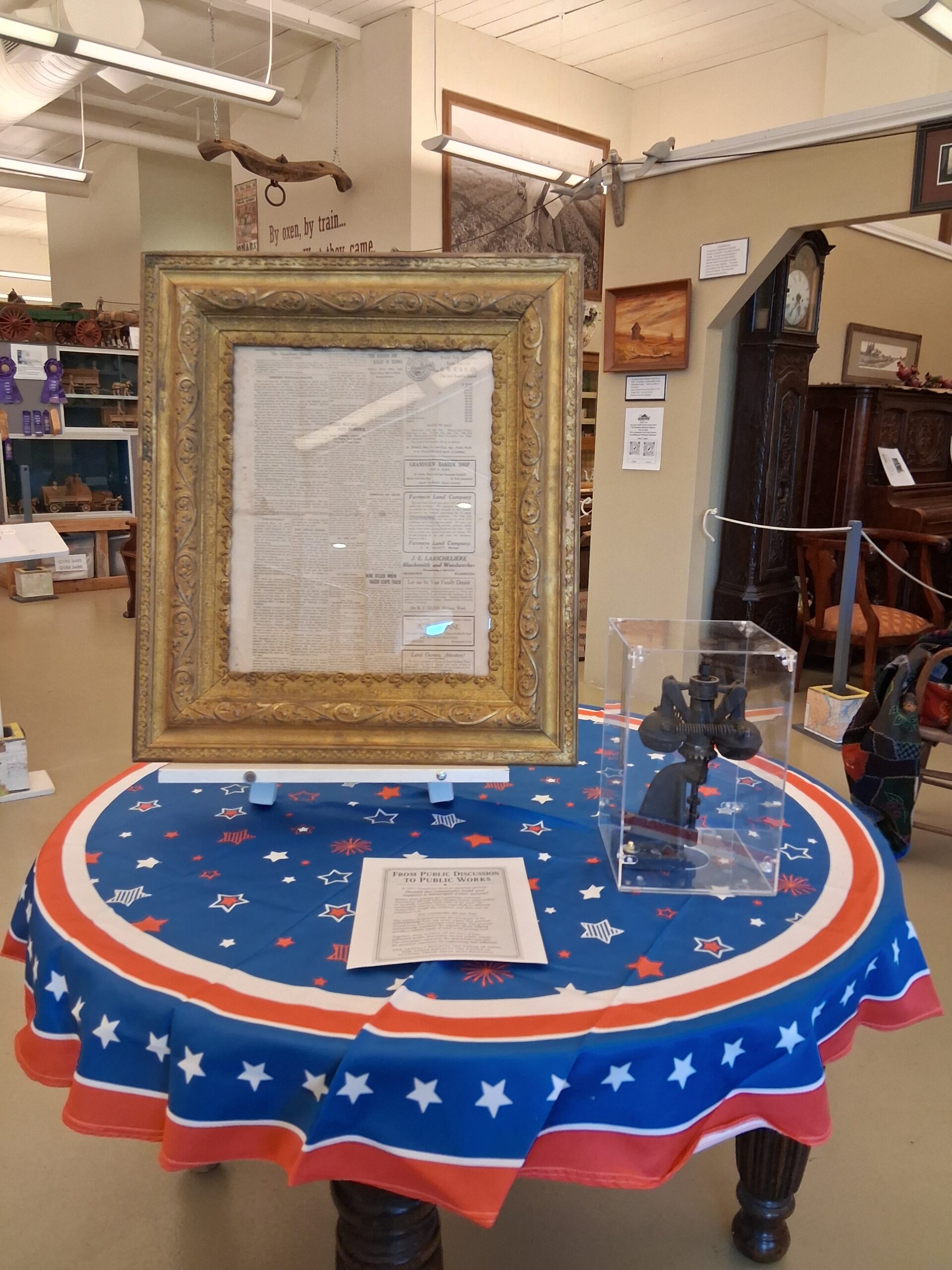
Visitors attending Washington Museum Day on August 8 discovered that the Grandview Museum had selected a single newspaper editorial as the artifact that best represents Grandview’s contribution to the 250-year history of the United States.
At first glance, it appeared to be an ordinary page from the Grandview Herald.
Upon closer examination, visitors discovered it recorded something much larger than local news.
It documented democracy at work.
The editorial, written by Grandview Herald editor/owner Chapin Foster in 1911, addressed one of the most important decisions facing the young community. Grandview was divided over whether to construct a municipal water system. One group believed the town needed a dependable supply of clean water and was willing to tax itself to build it. Others opposed additional taxes and were satisfied obtaining water from the Yakima River and the Sunnyside Canal, just as they always had.
Rather than telling readers what to think, Foster presented both viewpoints carefully and respectfully. He explained the arguments supporting the proposed water system as well as the concerns of those opposed to new taxes. Each position was allowed to speak for itself.
Then came the editorial’s remarkable conclusion.
Instead of urging citizens how to vote, Foster urged them to become voters worthy of a democracy.
He encouraged every resident to attend meetings held by both sides, listen carefully, study the issues, become well informed, and then cast a thoughtful ballot.
In that final paragraph, visitors encountered something larger than a discussion about water. They witnessed one of the First Amendment’s highest purposes—not simply protecting freedom of speech and freedom of the press, but encouraging an informed citizenry capable of governing itself.
The levy passed.
The community chose to invest in a municipal water system.
Wells were drilled.
Pumps were installed.
A water tower rose above Grandview.
Reliable public water became one of the foundations upon which the community continued to grow.
The exhibit invited visitors to see the newspaper not merely as an artifact, but as evidence of a community working through disagreement with civility, public discussion, and informed participation.
“As we considered what single artifact best represented Grandview in America’s 250-year story,” said Museum Curator Ray Vining, “we realized the answer was not the machinery that pumped the water or even the water tower itself. Those things were the result. The newspaper editorial captured the process by which ordinary citizens examined a difficult question, respected differing opinions, educated themselves, and chose a path forward together.”
In selecting the editorial, the Grandview Museum sought to remind visitors that the history of the United States is not written only by presidents, legislatures, or armies. It is also written in town halls, newspaper offices, public meetings, and polling places, where neighbors confront problems and, through informed self-government, determine the future of their communities.
The story told on Washington Museum Day was ultimately not about water.
It was about citizenship.
It was about the responsibilities that accompany the freedoms guaranteed by the First Amendment.
And it was about one small Washington town that demonstrated how democracy is strengthened when ordinary people commit themselves to becoming informed, engaged citizens.